Chitalpa (× Chitalpa tashkentensis)
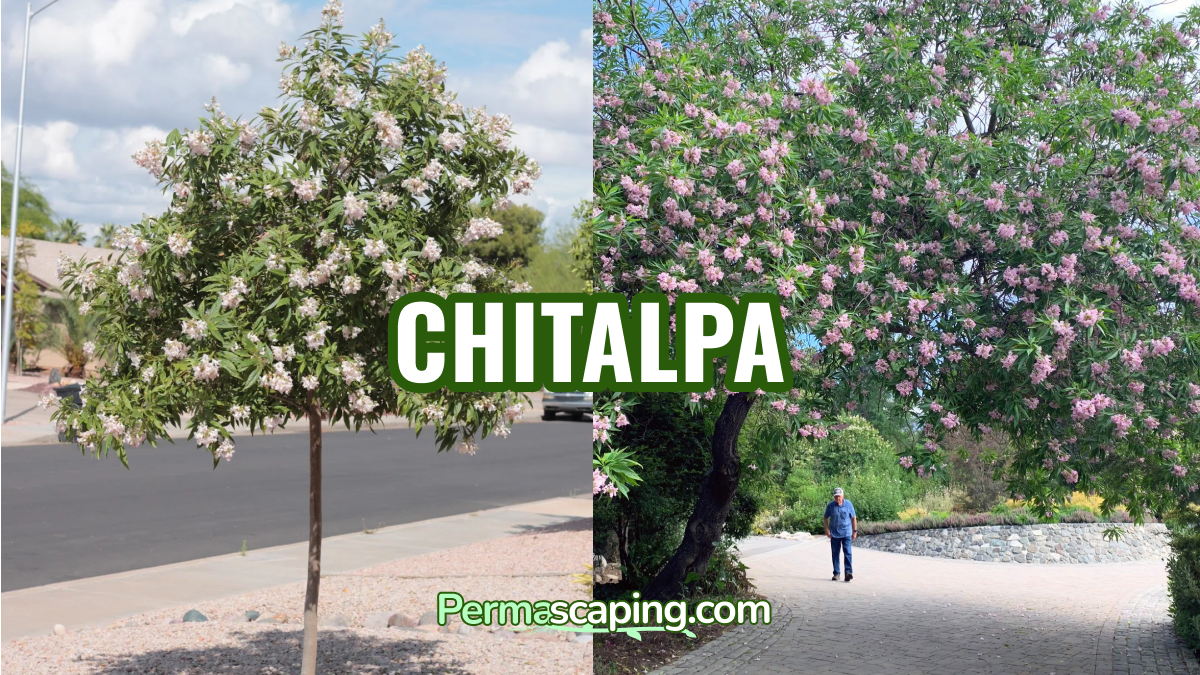
A hybrid that actually earns its place in the desert, the Chitalpa tree blends desert willow toughness with the lush, showy flowers of the catalpa tree. This creates a fast-growing, drought-tolerant shade tree that delivers months of blooms without demanding a ton of water, making it one of the most reliable “oasis-feel” trees for Phoenix landscapes!
Mature Canopy Size
20–30 ft wide, 20–35 ft tall
Growth Rate
Fast — 2–4 ft per year with irrigation
Water Requirements (Minimum vs. Maximum Growth)
Minimum: Low to moderate — deep watering every 2–3 weeks once established
For Maximum Growth & Bloom: Weekly deep watering in summer produces dense canopy and heavy flowering
Ecological & Functional Benefits
Hybrid of Desert Willow (Chilopsis linearis) × Catalpa (Catalpa bignonioides)
Attracts hummingbirds, bees, and pollinators
Provides light, filtered shade ideal for understory planting
More heat- and drought-tolerant than traditional flowering trees
Edible / Harvest Season / Nutritional Benefits
Not edible — grown for ornamental flowers
Produces long bloom season from late spring through fall
Maximizing Flower Production:
Full sun exposure is critical
Moderate watering increases bloom density without making the tree leggy
Light pruning after bloom flushes can encourage repeat flowering
Minimum Chill Hours
Low — generally performs well with minimal chill in desert climates
Maintenance Requirements
Low to moderate — prune annually to shape and remove crossing branches
Can drop some flowers and seed pods (light litter)
Thorny or Not?
No
Deciduous or Not?
Yes — loses leaves in winter
Root System
Moderately spreading, non-aggressive roots
Generally safe near patios, walkways, and pools with ~10–15 ft spacing
Less invasive than mesquite or ficus
Benefits from deep, infrequent watering to encourage stable root structure
Native Range
Not naturally occurring — hybrid developed in Uzbekistan (Tashkent).
Parents are native to the Southwestern U.S. (Chilopsis) and the Southeastern U.S. (Catalpa).
Miscellaneous Notes
One of the best “desert-adapted flowering shade trees” available
Flowers resemble desert willow but are often larger and more abundant
Sterile hybrid — typically does not produce viable seeds (less invasive, cleaner)
Great middle-ground tree: more ornamental than natives, less water-hungry than exotics
Questions about the Chitalpa?
Comment below or on our social media pages @permascaping.