Permascaping, by Homegrown Foods

How to plant a fruit tree in the low desert

The whole job, from the nursery pot to the first summer. Get these few things right and your tree roots out instead of just hanging on.

12-minute read · By Jérémy Chevallier · Updated October 2026

Fruit trees here don't just die from the heat. They often die from how they went into the ground.

I've planted a lot of trees across the Valley, with clients, volunteers and neighbors. The ones that struggle almost always share the same few mistakes: planted too deep, a rich hole dug into hard soil, and water that never gets past the root ball.

Here's the standard we use on every job. It's the same for a bare-root peach and a 15-gallon lemon. Only the first few steps change.

Thumbnail for the Blog & guides card and link previews. Click the photo to replace it; until then the main photo is used.

The short version

Six rules of thumb. If you only read this far, you'll still plant better than most.

  • Expose the root flare

    The spot where the trunk widens into roots sits right at the soil line. Never buried.

  • Dig wide, not deep

    Dig two to three times wider than the root ball, and no deeper.

  • Your own soil goes back in

    Backfill mostly with the dirt you dug out; max of 10-20% amendments. A hole full of compost turns into a bathtub.

  • Water long, deep, infrequently

    Soak the whole area the roots will grow into, not just the trunk. Use earthworks to ensure water doesn’t just flow away.

  • Mulch wide, keep trunk clear

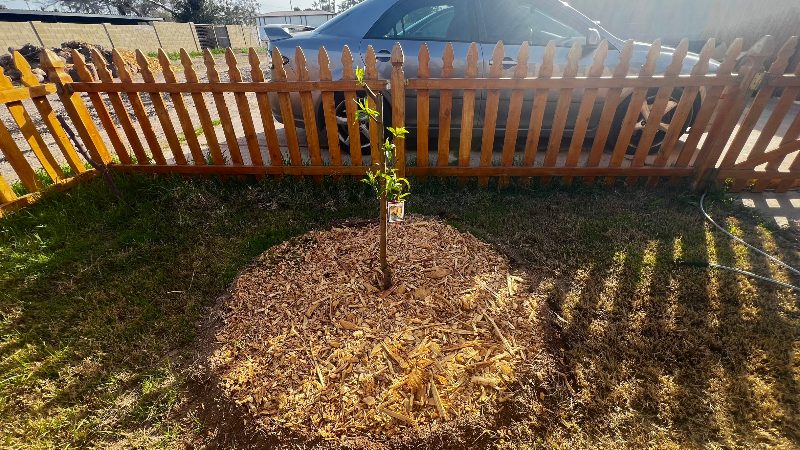
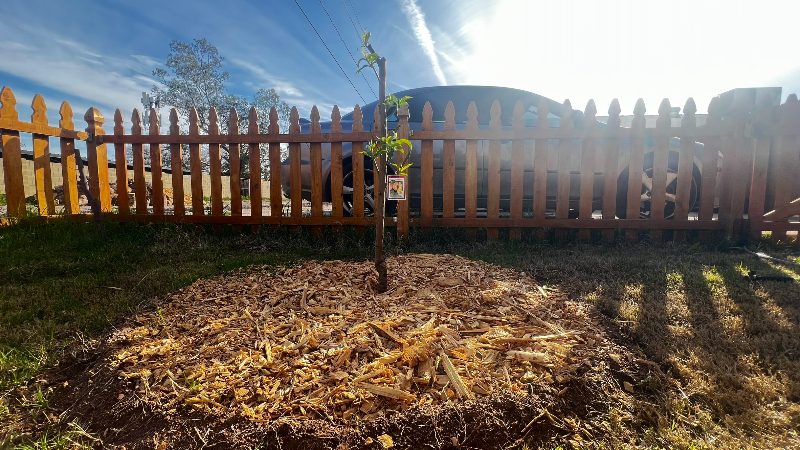
    Spread natural wood chips (6-12") across the root zone, pulled back a few inches from the trunk.

  • Shade the bark

    Young trunks sunburn. Use trunk wrap for the first couple summers or until the canopy is thick enough to shade itself.

Watch it done

A couple short reels that I will build on over time. Most of these apply to non-citrus trees too!

Part 1 Tips 1–4
Part 2 Tips 5–8

When to plant fruit trees in the desert

Timing does half the work—a tree planted in June spends its first year just trying not to die.

JFMAMJJASOND
Citrus and other evergreens
Bare-root deciduous (peach, apple, fig, pomegranate)

BestOkayBe extra careful

Our wholesale bare-root trees arrive in January or February, right in the dormant window.

Step by step

Pick how your tree came. The first steps are different; everything after them is the same.

  1. Soak it first

    Water the pot well the night before. A dry root ball pulled into dry ground stays dry, no matter how much you water after.

  2. Find the root flare

    Brush soil off the top of the pot until you see the first big roots. Nursery trees are often potted too deep, so it's usually an inch or two down.

    Planted too deep: the flare (arrows) should sit at the surface, not under it.
  3. Fix circling roots

    Roots that wrap around the pot keep wrapping in the ground. Tease them loose, or slice through them in three or four places. It looks harsh. It saves the tree.

  4. Dig wide, not deep

    Two to three times as wide as the root ball, and only as deep as the root ball is to its flare. Set it on firm, undug soil so it can't sink.

  5. Backfill with mostly your own soil

    Don’t use more than 10-20% compost/soil amendments. Put back the dirt you dug out. Water it in as you go to settle it and push out air pockets, instead of stomping it down. Then check the flare is still at the surface.

  6. Water where the roots are going

    Start with emitters near the root ball, then move them outward as the tree grows. Roots go where the water is—and tree roots are wired to go searching far and wide.

Then, for every tree

Mulch the whole root zone, keep it off the trunk, and protect young bark from sun and string trimmers.

Wide mulch, trunk clear, water headed outward.

How to water your newly planted fruit trees

Deep, then less often. That's the whole secret. Here's a starting point; your soil decides the rest.

WhenHow oftenWhat to aim for
First 2 weeksEvery 2 to 3 daysSoak the root ball and the soil around it.
First summerAbout every 5 to 7 daysDeep, about 2 feet down.
First winterEvery 10 to 14 daysLess if it rains.
Year two onDeep and less oftenWater out to the edge of the canopy and beyond.
The two-inch test: dry here means water today.

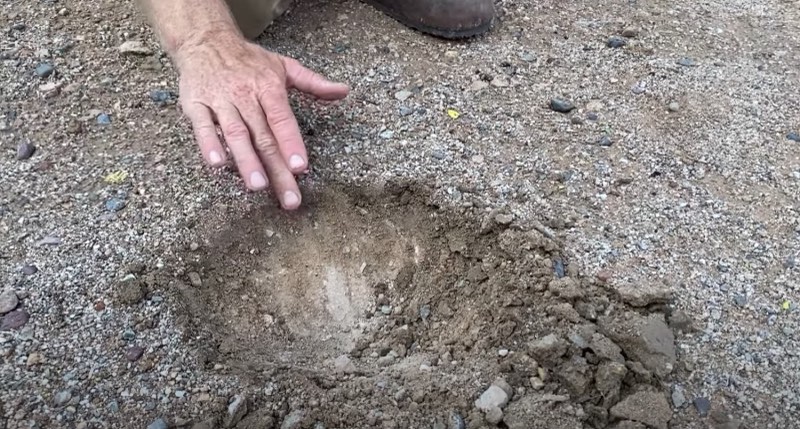
Not sure? Dig 2 inches down with your finger. Dry there means it's time. Wet means wait, even if the leaves look sad. Too much water looks a lot like too little.

Where to plant your fruit trees

Citrus keeps its leaves all year, so it shades whatever is behind it in winter too. Pick the spot by the variety: some burn in west sun, others need that heat to ripen.

Morning sun · afternoon shadeEast end of the sunnier, south-facing side

Improved Meyer · Variegated Pink Eureka · Ponderosa · Kaffir lime · Moro blood · Cara Cara · Parent Washington · Clementine

Why: Thin skin, variegated leaves, and blood oranges that need cool afternoons to color

Morning and afternoon sunOpen south-facing side

Arizona Sweet · Trovita · Olinda · Early Hamlin · Minneola · Orlando · W. Murcott · Freemont · Daisy · Tango · Golden Nugget

Why: Tough enough for full exposure, and more productive for the extra hours

Morning shade · hot afternoon sunWest end of the sunnier, south-facing side

Rio Red · Ruby Red · Oro Blanco · Red pummelo · Mexican key lime · Mexican Thornless · Bearss · Limequat · Eureka · Lisbon

Why: Heat finishes the fruit, and the wall gives the frost-tender ones warmth overnight

Morning shade · partial afternoon sunWest end of the shadier, north-facing side

Kumquat · Calamondin

Why: The two that take part shade and shrug off cold

Zones E and F are left out on purpose. Citrus needs six or more hours of direct sun to fruit, and neither gets it. The one exception is a potted kaffir lime, where the leaves are the crop.

Deciduous trees (peaches, figs, pomegranates) drop their leaves in winter. That makes them great on the south and west side, where you want summer shade and winter sun.

Mistakes we see all the time

Every one of these sounds right. Every one of them costs trees.

  • You'll hearFill the hole with compost so it has good soil.

    Do this insteadCompost goes on top as mulch, not in the hole. A rich hole in hard soil holds water like a pot, and roots circle in it.

  • You'll hearPut the drip right at the trunk.

    Do this insteadEmitters at the trunk keep roots small and the trunk wet. Move them out to where the roots should be heading.

  • You'll hearPlant it a little deep so it's sturdy.

    Do this insteadBuried bark rots. The flare sits at the surface, every time.

  • You'll hearWater a little every day.

    Do this insteadShallow daily water grows shallow roots. Water deep, then let the top dry a bit.

  • You'll hearLeave the nursery stake on.

    Do this insteadA tight stake makes a weak trunk. Pull it at planting, or tie it loose and take it off within a year.

Questions

How big a hole do I need?

Two to three times as wide as the root ball, and no deeper than the root ball is to its flare.

Should I fertilize when I plant?

No. Let the roots settle first. Start feeding lightly once you see new growth, and keep to a plan through the year.

Do I need to amend my soil?

Not in the planting hole. Improve the whole area over time with wood chip mulch, and the soil life does the rest.

The leaves are curling or yellow since I planted it. Now what?

A few weeks of transplant shock is normal. Check the soil 2 inches down before you add water, because overwatering looks a lot like underwatering.

Can I plant in summer?

You can, but it's hard on the tree. If you have to, shade it for the first month and water more often.

When do bare-root trees arrive?

Our wholesale bare-root trees arrive in January or February, while they're dormant. That's the best time to plant them.

Plant it right once, and it feeds you for decades.

Questions about your yard? Press Help on any page and it comes straight to me.