
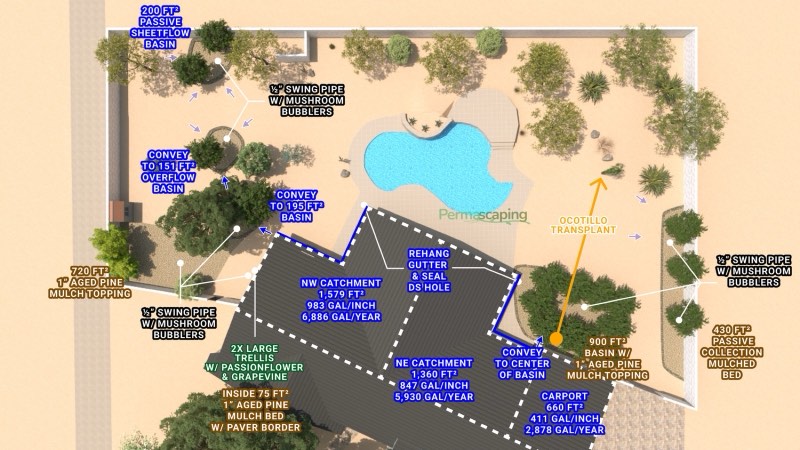
The zones of permaculture, for a home in the desert
Permaculture sorts a property by how often you visit each part of it, from the house outward. Here is what that looks like on a typical Phoenix lot, zone by zone, and how the idea keeps going past your fence.
What a zone is
Traditionally, permaculture uses zones to organize the elements of a property by how often they are interacted with. The things you touch every day go nearest the door. The things that can look after themselves go farthest away. As with the principles of permaculture and most other ideas in it, the details vary from source to source, and the diagrams you find are drawn for farms: a house in the middle, a kitchen garden around it, then orchards, then pasture, then woodlot, then wilderness.
Almost nobody in the permaculture world talks about how that applies when you have a few hundred square feet surrounded by block walls instead of acres. The framework below is the one we use on client projects and on our own properties in the Phoenix Valley. Keep in mind that zones overlap. They are not bright lines painted on the ground.
Zones 0 to 5 on a Phoenix lot
The house in the middle, the wild on the outside, and four rings in between. The ring that matters most on a small lot is the first one.
- 0
Zone 0: The houseYou are in it every day
The center of the whole system, and the one part you cannot move. Every roof surface sheds rain, and the shower, the bathroom sinks and the washing machine send out greywater. Both are water the landscape can take, and in a dry climate both are worth more than they look.
On a Phoenix lot. The roof and the downspouts. On a Phoenix lot the roof is often the single biggest catchment on the property, bigger than the yard it drains onto.
- 1
Zone 1: DailyVisited every day
Everything you pass or tend on the way in and out: kitchen herbs, salad greens, the chard and kale of the cool season, a few pots of what you cook with. The greywater-fed bed belongs here too, because it gets water whether you remember it or not and needs an eye kept on it.
On a Phoenix lot. The patio and the few steps around the back door, the strip along the laundry-room wall where the washer drains, and the front walk if the kitchen looks that way.
- 2
Zone 2: WeeklyVisited a few times a week
The fruit trees, the chickens if you keep them, and the compost. These need attention on a rhythm, not a schedule: a harvest, a deep watering, a bucket of scraps. This is where most of the food on a suburban lot comes from, and where the shade that makes the yard usable in summer lives.
On a Phoenix lot. The main back yard, from the patio edge to the block wall, and the planted part of the front yard. The compost and the coop go in a corner you can reach but do not sit next to.
Place the fruit trees at mature width in the planting planner
- 3
Zone 3: OccasionalVisited a few times a season
The orchard rows, staple crops, and the rain basins that do their work without you. On a farm this is the hay field. On a lot it is the planting that runs on rain and mulch once established: mesquite over a basin, a jujube by the curb, a row of pomegranates along the wall.
On a Phoenix lot. The front yard beyond the walk, the curbside strip and the basins that catch the street and roof runoff, and the side yards with the rain tanks and the air-conditioning units. The old post called this the extended yard: the alley with the trash cans and any easements with usage restrictions belong here too. They have a purpose, housing the tanks, the tool shed and the vehicles, and they are the right place for slow, low-maintenance work such as soil remediation and passive rainwater harvesting.
Size the basins for the roof and the street in the watershed planner
- 4
Zone 4: Semi-wildVisited a few times a year
Natives that look after themselves and give something back: mesquite pods for flour, ironwood and palo verde for nurse shade, prunings for firewood and chipped mulch, a thicket of hackberry for the birds. Managed lightly, harvested when there is something to harvest, otherwise left alone.
On a Phoenix lot. The back corners and the strip along the back wall, the alley edge, a wash or drainage easement if the lot has one. On most Phoenix lots this zone is a few hundred square feet; on an acre lot in the outskirts it can be most of the ground.
- 5
Zone 5: WildObservation only
The part you do not manage at all. You go there to watch how the desert does it without you: what comes up after a monsoon, where the water goes, which plants the birds choose. It is the reference the other zones are measured against.
On a Phoenix lot. The corner nobody waters, the preserve behind the wall, the common area the HOA mows, the empty lot at the end of the street. The point is to have somewhere to look, not to own it.
Past the fence: your block, your neighborhood, everywhere else
A suburban lot runs out of ground fast. The zones do not have to stop there.
Your block. Your immediate neighbors, the common areas, the park: the places you can see with your own eyes standing on your property. This is perhaps the best opportunity in suburban permaculture, and your best shot at changing your neighborhood. Partly by showing what is possible in your own yard, and partly by engaging the neighbors directly: conversation, garden exchange stands, block parties and Permablitzes, where a group builds one yard in a day and learns how to do the next one.
Your neighborhood. The whole development your home belongs to, anywhere from a couple dozen houses to hundreds, sometimes with retail and commercial space mixed in. It gets harder to do a whole lot from here, but not impossible. Individual action is possible, though sometimes risky: sowing wildflower seed in neglected corners, stewarding common areas with chop-and-drop mowing and shrub trimming, even reshaping ground that nobody is looking after. This is where community action and neighborhood organizations really shine, for those with the mettle to take them on. The Phoenix Food Forest Initiative is one project crossing from the block to the whole neighborhood. Another is the Dunbar/Spring neighborhood in Tucson, where Brad Lancaster pioneered an organized suburban rainwater harvesting and native planting movement.
Everywhere else. Beyond the neighborhood is the city, the county and state, the country, and the rest of the world. There is more planting and stewardship to do out there, and there is activism. Lancaster and his neighbors were technically breaking the law when they started cutting curbs to harvest street runoff. With time and a great deal of effort they got the City of Tucson to rewrite its rules to allow it, to offer rebates, and to build the practice into its own public works. Phoenix Valley cities have been slower, though several run their own programs, such as the City of Phoenix's G.A.I.N. events, which are a good reminder that these zones blend into one another.
Where exactly do you draw the line between your block and your neighborhood, or your neighborhood and your city? It does not matter nearly as much as practicing the principles wherever you go, and passing them on to everyone else.
Adapted from the original post, The 6 Zones of Urban Permaculture.
Draw your zones on your own lot
Three free tools, one address. Each one answers a question the zones raise.
Microclimates
Where the sun and the afternoon shade fall on your lot, by hour and season. It decides what zone 1 and zone 2 can hold.Open the microclimate analyzer →Watershed planner
Trace the roof, the gutters and the basins, and see how much water zone 0 can send to zones 1 through 3.Open the watershed planner →Planting planner
Place every tree and shrub on an aerial of your yard at its mature width, filed by layer, and order the trees from the same plan.Open the planting planner →
Want help placing the zones?
Whether you are doing all of it yourself or hiring as much as possible, tell us about your property and we will set up a free discovery call. We will walk the lot with you on a map and say what belongs where.