

Community
Key sites to visit in the Phoenix Valley
Working permaculture and desert-adapted sites within a drive of Phoenix, what to look for at each, and how to read any site once you are standing in it.
Plans and photos only go so far. A basin on a screen is a shape; a basin in the ground after a monsoon is a lesson in where water actually goes. The fastest way to learn what works in the low desert is to walk sites where it has been working for years and look closely.
These are the places we send people. Some are gardens, some are farms, two are in Tucson and worth the drive. None of them need a guide, but every one of them rewards a slow walk with the checklist at the bottom of this page in hand. Check each site's own website for hours, admission and what is in season before you go.
Where they are
Every site on one map. Click a pin to jump to it, and open any of them in the map you already use.
Click a pin to jump to that site.
The sites
What each one is, and what to look for while you are there.
Phoenix Food Forest
Across the Valley
Our partner project, led by Christopher Macy: a network of volunteer-built food forest plantings meant to blanket the entire Valley of the Sun. Permascaping designs and leads planting days with them.
What to see. The plantings are young, which is the point. Watch how a basin is shaped before a tree goes in, how deep the mulch is laid, and how much the first year's growth depends on where the water was sent.
Desert Botanical Garden
Phoenix
The Valley's reference collection of Sonoran Desert plants, laid out along walking trails in Papago Park. Its desert living areas show how native and desert-adapted plants are used around a home, not just in the wild.
What to see. Plant combinations that handle full Phoenix sun without irrigation, the way canopy trees shade understory shrubs, and the labels: it is the easiest place to learn what a mature native looks like before you buy a small one.
Boyce Thompson Arboretum
Superior
Arizona's oldest and largest botanical garden, about an hour east of Phoenix, with arid-land trees and plants from deserts around the world set along a creek canyon.
What to see. Trees. Mesquites, acacias, ironwoods and their relatives from several continents, grown to full size, so you can see the canopy you are planting toward. Notice how much cooler it is under the big ones.
Spaces of Opportunity
South Phoenix
An urban farm in South Phoenix with incubator plots for growers, community garden beds and a farmers market. Food production at a scale between a backyard and a farm.
What to see. How a working grower lays out beds, shade and irrigation in the low desert, which crops are in the ground in each season, and the market itself, which is in our directory.

Chandler Nature Center
Chandler
The city's environmental education center at Veterans Oasis Park, next to recharge wetlands and desert plantings. We have held mesquite milling classes there, turning Valley pods into flour.
What to see. Native mesquites and the pods they drop, the wetland that recharges the aquifer with reclaimed water, and the program calendar: it is one of the Valley's steadier places to learn a desert food skill.
Riparian Preserve at Water Ranch
Gilbert
A preserve where Gilbert's reclaimed water recharges the aquifer through a series of ponds, with trails through the desert and riparian plantings around them. One of the best birding spots in the metro.
What to see. What water does to a desert when it stays. Compare the plant density beside the ponds with the dry uplands a few steps away, and notice which trees the birds use.
Mission Garden
Tucson
A living agricultural museum at the base of Sentinel Peak, on land farmed for thousands of years. Heritage orchards, timeline gardens from O'odham and Spanish mission plantings to today, and acequia-style irrigation.
What to see. The heritage fruit trees: figs, pomegranates, quinces and citrus that have proven themselves in the Sonoran Desert for centuries. And the acequias, a reminder that moving water on the surface is older and simpler than drip.
Watershed Management Group's Living Lab
Tucson
The demonstration site and learning center of a nonprofit that has shaped how the Southwest thinks about rainwater and greywater. Their campus runs on what it catches.
What to see. Curb cuts feeding street-side basins, roof water into tanks, laundry and shower greywater into the orchard, and a composting toilet. The clearest place to see every water source on a property put to work at once.
What to look for on any visit
The same six things tell you whether a site works, whether it is a botanical garden or your neighbor's front yard.
- Basins and bermsFind the low spots. Is the planting in the basin or on the berm? Where does the overflow go when the basin fills?
- Mulch depthPush a finger in. Three to four inches of wood chips holds moisture and feeds soil; a thin scatter of gravel does neither.
- Canopy layersCount the layers: tall shade trees, smaller fruit trees, shrubs, ground cover. The more layers, the cooler and more productive the ground.
- Where the water goesFollow a roof edge or a path downhill. Water that leaves the property is water the plants never got.
- Sun and shadeNote what is planted on the west side of a wall versus the east. The best sites put the toughest plants where the afternoon sun hits.
- What is thrivingWrite down the names of the plants that look best with the least care. That list is your shopping list.
Yards you can read about
Not open to visitors, but documented from before to after, with the numbers.
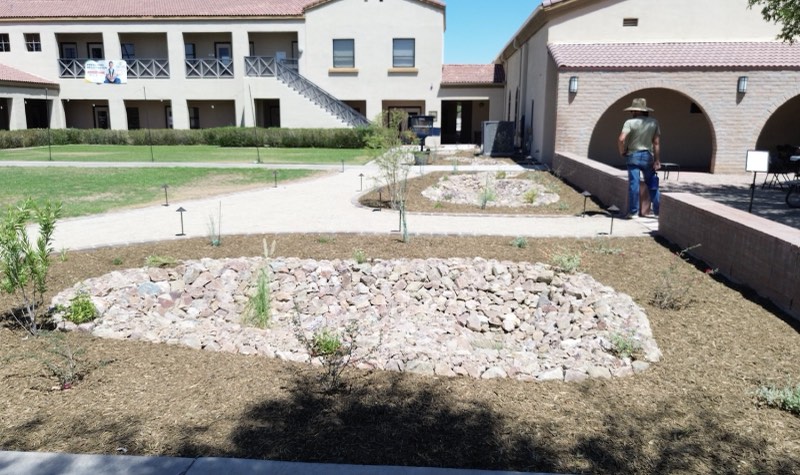
A Rainwater-Fed Community Landscape for First United Methodist Church of Gilbert
This installation is open to the public! 331 S Cooper Rd, Gilbert, AZ 85233Read the case study →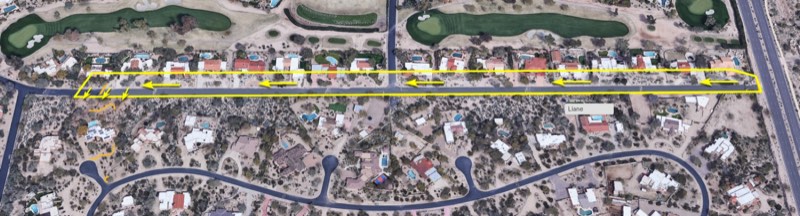
Harnessing the Storms: Massive Suburban Rainwater Sheetflow Control
Many years ago, Liane and David bought a gorgeous property in North Scottsdale with an expansive landscape full of Sonoran Desert native trees and shrubs… and, they unintentiona…Read the case study →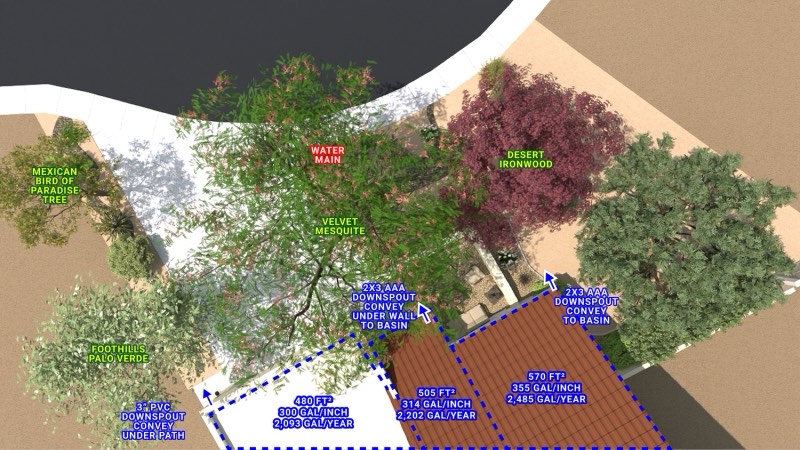
Replacing Unused Lawn with a Rainwater-Fed, Native Sonoran Permascape in Tempe AZ
Tyler Post first approached Galaxy Gardens about 2 years ago, and our friend & long-time native permaculture designer Nancy Blakley produced a beautiful & functional design of S…Read the case study →
Go with people who can explain it
Our workdays and classes happen at sites like these. Join one and you get the walk and the why at the same time.